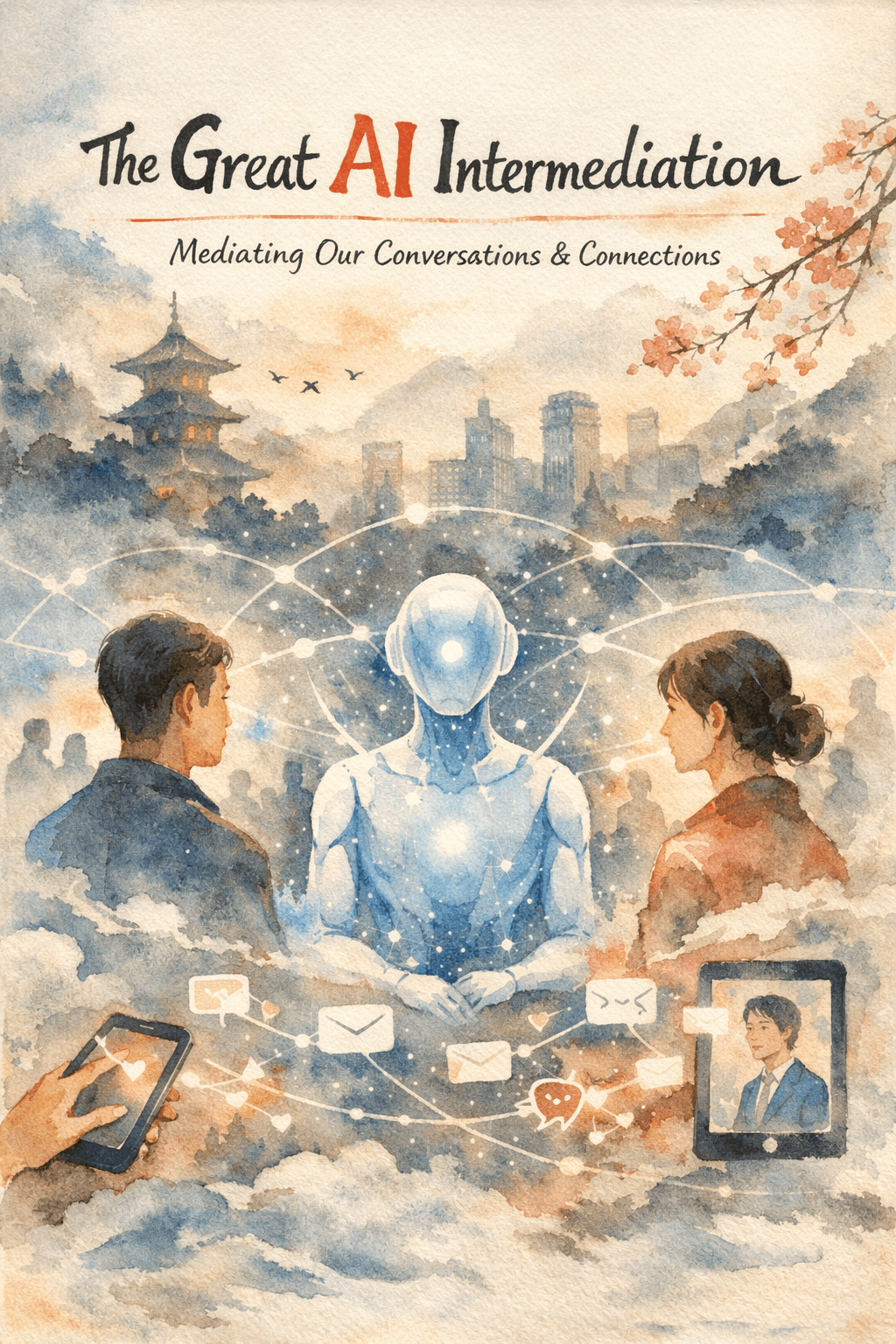
The Great AI Intermediation
How AI will increasingly mediate our conversations, connections, and collective experience
Over the next few years, the major tech companies such as OpenAI, Google, and Meta, will ship increasingly powerful, personalized, AI experiences that will have ever deeper context on everything about you. AI memory and context are one of the major focuses of AI companies these days, and they are seen as competitive moats in building uniquely personalized services.
These AI models will deeply understand who you are, your life story to date, the rhythms and commitments of your daily life, what your plans and aspirations are, what your important relationships are, what’s on your mind, what you’re concerned about and what persuades you. If you thought your Google search history was a telling representation of you as a person, that slice of context is already small in comparison to the sort of knowledge and insight that OpenAI and other AI assistants have based on your conversations and activity. Just imagine how exposed you would feel if your ChatGPT or Claude conversation history were publicly leaked.
This tradeoff of context (data & privacy) for convenience is a bargain that has been unfolding between tech companies and consumers since the early days of the web and personalization.
“Data is the moat” is a familiar adage. One rendition of this is that if you have more data about customers, you can build more personalized services for them than your competitors, and so you’ll win an increasing share of the market.[1]
Cast in a positive light, these personalized, context-rich AI will allow new types of products to be built that will bring immense amounts of value to people’s everyday lives. You will have always on, highly personalized assistants, teachers, coaches, therapists, trainers, doctors. But what is worth paying attention to, is that they will also start to mediate almost every interaction we have with one another as humans. More and more, instead of speaking directly to each other, we’ll speak through AI to each other. Given that these AI are largely operated by companies, it means we’ll be effectively speaking through companies to one another.
We’ll increasingly make more and more of our planning, buying, personal, and political decisions, based on the advice of these highly intelligent, deeply contextual AI services. These AI assistants will in many ways reshape what it means to be a person living with technology in society, and what it means to be together as humans. We are all in a dynamic conversation with this reshaping.
The great ongoing question and conversation of humanity and society is: Who are we? How do we want to be? How do we want to spend our time? And how do we want to be together?
Conversation, context, combination, contact, these are in many ways the aspects that shape how we come together, and they will increasingly be mediated and moderated by this AI inter-space. I wanted to touch on a few different aspects of the ways that AI will enter our conversations and connections:
- AI as translator and intermediator: AI will increasingly be used to write, modify and deliver the messages we send to one another
- AI as substitute for people: We will increasingly be speaking to AI, rather than to humans - more and more of our conversations will be human to AI, rather than human to human.
- AI as moderator: AI can and likely will be increasingly used to help mediate our conversations, hopefully to help us make better contact with one another
- AI as connector: AI will increasingly be used to connect us to content, products & people - it will implicitly be more and more responsible for allocating our attention.
In general, my belief is that we should be having more human to human conversations about how AI is infusing our lives, and how we can best weave this rapidly improving technology to help shape the sort of lives and societies we hope to have. This essay is a reflection and invitation to imagine around some of the beautiful opportunities, and concerning aspects of these new AI-mediated ways of being and connecting.
The medium decides the message
Products like ChatGPT are already being used to mediate how we speak to one another at scale, and this is just the beginning. Consider how often folks nowadays ask ChatGPT to write messages to send to friends, colleagues, or potential employers. As my friend joked the other day when speaking to a contractor he was working with: “We’ll let our ChatGPTs talk it out, and negotiate from here, no need for us to talk directly”.
It’s becoming increasingly common to find yourself on the receiving end of a message wondering if a human wrote it, or an AI wrote it. As these AI services become more embedded in the surfaces where we write, listen and speak, it’s likely those products will increasingly cue us to have AI write or edit our messages to one another. Just take a look at the example I included from dating app Hinge further below.
Over time, these AI will be increasingly trained on our likeness (the way we communicate, sound, and look), or on our desired likeness, such that they are avatars of us or how we would like to be perceived. Folks will engage with our avatars, or our avatars will engage with each other directly as an intermediary between us.
The other week I was at a workshop on the topic of authenticity, where the presenter told a story about a conversation with Esther Perel. Esther Perel, who is a popular relationship therapist, pointed out that one challenge of these new AI writing machines is that before, if you received a long thoughtful note from someone reflecting on an experience or interaction you had, you knew they took the time to have that reflection and write the note themselves. There was meaning in the connection - it symbolized the other person processed something, and took the care and time to write you that note. Now, with these new AI tools you can’t be fully sure if they actually processed and reflected or if they just had an AI quickly write and deliver a note that seemed thoughtful and meaningful, but with no substance behind it.
Speaking through AI - AI as translator and intermediator
More and more, we’ll have communication between us that is intermediated by AI - where we don’t quite speak directly to one another. Recent releases like Apple’s Live Translation feature are a glimpse of what’s to come. These features allow you to have real-time voice and written conversations with people who speak different languages than you, as the service translates the words and meaning in realtime. They’re shipping this natively into Airpods, Messages, and Phone / Video calls.
Along these lines, there’s companies that are removing accents from the voices of speakers: Sanas.ai
Services like Hume.ai have worked to plot human emotion, so that you could also steer what the generated AI voices sound like:
It’s reasonable to project this out, and imagine that we will be able to use these language & voice modification features to modify the dialect, tone/mood, or style being received. Every aspect and sense of the contact can be modified and mediated in real time. You’ll speak, but you will speak through AI.
The medium is the message, and now the medium decides the message. The AI is the medium through which we will interact. But, unlike previous mediums (think the phone, television or the internet), this medium is itself intelligent and alters and even decides the messages that are delivered more profoundly than any previous mediums.
When I think about this AI translator intermediator space, I get images of the tower of Babel, and the strange Ur language that we get not by having a shared language, but by having a universal language adapter that is AI.
One corollary of the notion that AI will have increasingly high context on each of us, and be able to translate between us, and that we’ll be spending more and more time talking to AIs, is that we may each develop highly specialized dialects for conversing with the AI. Think about your deepest friendships, and how a word or gesture can carry so much contextual information. It’s very likely that AI will get to know us, and our language so deeply, that we’ll have highly specific, contextualized dialects with the AI, where shorthands are able to carry immense communicative power given their surrounding context. Language exists in context, and with increasing context, we can have further compression in our communication, and so we could expect to see AI that understands us very deeply given the context, that can support highly specialized dialects, and is also able to message our deeper intent to one another. AI is a language compressor enhancer, the way paper is a memory enhancer, AI could meaningfully reshape the space of language.
A downstream corollary of this though, is that we may have an increasingly hard time understanding one another without AI, as we don’t understand one another’s highly specialized dialects. Just the way that now we have a harder time navigating in the real world without the use of Google Maps like technology.
The other big trend to watch in this AI translator space, is how the rise of brain machine interfaces will intersect with AI. It seems that this technology is not only feasible, but becoming commercialized within the next few decades.[3]
Questions to consider:
- What happens to our sense of connection and a sense of authenticity in this intermediated world?
- What happens to languages when folks don’t have as much use for learning each other’s languages due to AI translators?
See this footnote for a fun experimental idea along these lines.[2]
AI as a substitute for people: Am I speaking to an AI?
Along these lines, increasingly we’ll also have to ask ourselves, am I speaking to a human, or am I speaking to an AI? What’s on the other side of this conversation?
On aggregate, I think we’re all having more conversations in general than we probably were having before ChatGPT launched - there’s more conversations happening in general. The critical difference though is that more and more of our conversations are with AI rather than humans. These AI services like ChatGPT can perform the function of an always available coach, therapist, educator, coworker, friend or romantic partner. Moreover, as the AI’s capabilities continue to improve, both over voice and video, we’ll increasingly tap into these AI services, and we’ll also increasingly be unsure about whether we’re interacting with humans or AI on the other side.
Consider if we were to map the dramatic rise in the following charts:
- How much time are folks spending talking to AI (or the ratio of talking to AI vs talking to humans)? We’ve gone from not talking to AI at all, to conversing with it a greater and greater number of hours per week. I personally use it as an always on therapist, coach, doctor and more.
- How many of the messages humans send to each other, are written, or edited by AI? Again, we went from none of our messages being edited or originated by AI, to a much larger number of them being so - and this is only likely to increase.
On the one hand, this could all be seen as really promising - the idea of everyone having the best teacher, coach, therapist, doctor and coworker, focused on you and your context, and always available 24/7, is a pretty amazing premise.
On the other hand, we should wonder about what the impact will be for each of us when more and more interactions occur with AI rather than humans. It’s also worth considering what it means for us to be having more and more of our deepest conversations with services provided by companies, instead of with our friends, family, and trusted professionals. We’ll increasingly have to grapple with trust, and our sense of reality, as these AI generated media and interactions become increasingly indistinguishable from reality. We’ll increasingly have to grapple with the question of what the value of the real thing, as opposed to the substitute is.
One person that I’ve always thought of as exploring the role of conversation and technology in society is Sherry Turkle. She’s an MIT sociology professor who researches the role of technology and conversation, and has written books I’ve loved like Reclaiming Conversation: The Power of Talk in a Digital Age (2016), and Alone Together: Why We Expect More from Technology and Less from Each Other (2017). I was pleasantly surprised while writing this piece to see that she’s been engaging with these questions broadly under the topic of Artificial Intimacy:

AI as a moderator and participant in our conversations
An approach that I’m surprised hasn’t been explored more which I’m hopeful for, is using AI to help moderate our conversations and leveraging it to help us better understand and connect with each other.
(Since I wrote this post back in September 2025, I’ve seen at least one excellent example of this, which is Hinge Convo Starters)
What are Convo Starters?Starting a conversation can sometimes feel awkward or intimidating. Many daters say they hesitate to send the first message because they’re not sure what to say. Convo Starters is a new feature that gives daters personalized ideas for how to start a conversation, inspired by the Prompt answers and photos on someone’s profile. These AI-generated tips are meant to inspire you, not write the message for you – you decide what to send and how to make it your own. Our testing suggested that using Convo Starters helped daters feel more confident sending a first message.
So often, we stumble when we try to understand or get to know one another - we miss each other’s meanings, we project and misunderstand who the other person is, we don’t have enough context. Sometimes, there’s a sense that we maybe don’t have enough time to have all the conversations that we should be having - but often, we’re together, and we end up not having the conversations we wish we were having, we end up not getting to the understanding we longed for. A lot of what we long for from one another ends up being this contact, and understanding - feeling seen and connected.[4]
I think about how often, really simple prompts and practices can really improve our ability to understand and foster better conversations with each other. Whether that’s something as simple as games that give us good questions to ask each other like Get Closer, or the 36 questions to fall in love, or practices for slowing down, checking in and tuning into our awareness before engaging in conversation.
I believe that structure to our interactions can be a great facilitator to human connection - it’s setting ourselves up for success, it’s giving ourselves the rails and systems for the type of contact we want to make. I’m a regular practitioner of something called Gestalt Practice, which in many ways is just a set of practices, norms and exercises for sitting together as a group, honing awareness, and making present contact with one another. Having a structure allows everyone to show up the way they would like to show.
Examples in this direction are:
- Leveraging AI to both get people in the right mindset before entering a conversation, and to help start conversations between people around what they might want to ask each other
- AI that act as group or couples therapists, where the AI has sufficient context on each participant and can help them not miss one another
- AI employed in conflict mediation and resolution generally
AI as participants
We can also think of AI as participants in our conversations and social networks, rather than inherently as moderators. Folks have been employing negative versions of this, in the form of bots used to spam, or participate in conversation in order to create misunderstanding and foment division - for example Russia is presumed to have used these techniques to have created more civil unrest and instability abroad via posting on anonymous social networks (Russian web brigades).
It’s interesting to think about what AI as participants in their own conversations, or engaging beneficially in a social network could be as well. It turns out, as we’ve seen over the last 20 years, that social networks have an immense impact over our shared experience of life, and so the role of AI in these social networks and how it reshapes what a social network is, will have immense importance for our social and political fabric.
Some of these ideas might feel silly, but the impact of making our conversations and conversational spaces have more authenticity and substance could be… substantial. I’m hopeful in these sort of AI nudges and social lubricants. I’m also hopeful for what new types of social networks are possible given AI, but more on that in another post.
AI as connector: the everything feed
These AI will also increasingly decide what information we see, what products we buy, where we go, who we meet, what goals we set for ourselves, and what we think and value. AI products will become increasingly proactive: we will move from us starting the interaction, to the AI initiating the interaction and pushing us suggestions.
We’re in the early innings of all this. We’ll soon have more and more, highly context-aware personalized assistants and matchmakers. Glimpses of this trend can be seen in two of the launches OpenAI had these past weeks:
- ChatGPT Pulse (Sep 25th, 2025), a push-based service that suggests content to you based on the past conversations you’ve had with AI - Introducing ChatGPT Pulse
- Buy in ChatGPT. The ability to check out and purchase products within ChatGPT, which if you play that out is reasonable to imagine that more and more buying decisions and interactions will happen through ChatGPT, and these models will direct increasingly large swathes of economic activity. Buy it in ChatGPT: Instant Checkout and the Agentic Commerce Protocol
(To give an update, since I wrote this post in late September 2025, I am using ChatGPT’s pulse feature to consume articles and advice written for me, on a nearly daily basis. I’m regularly surprised by the specificity of the content - it writes me articles with idea suggestions about the work I’m doing in AI coding, and highly specific advice about my nutrition, health, and daily calendar activities - I think we’re in the very early days of this proactive, personalized, push based AI phenomenon)
It seems reasonable to expect that AI will soon give us a hyper-personalized feeds of content, products, people, and experiences to fill our time. It will suggest to us, “hey, you should read this because you were curious about that”, “hey, you should meet this other person who has shared interests to collaborate with them, or befriend them, or date them”, “you should buy this product because it will help you accomplish this goal you’ve been talking to me about”. These AI will become the great social connectome. We will be left asking ourselves at times, did I choose this, or did the AI choose this for me… and what’s the difference?
Please don’t feed me… I’m full…
The AI Social Fabric
The strangeness of the whole thing, is that these AI are the byproduct of all the data we’ve put on the web, they are trained on that data, and tuned and steered by these AI companies - they are shaped by us, and in turn they will deeply shape our collective experience. Remembering that adage from McLuhan as paraphrased by Culkin:
Life imitates art. We shape our tools and thereafter they shape us. These extensions of our senses begin to interact with our senses. These media become a massage. The new change in the environment creates a new balance among the senses. No sense operates in isolation. The full sensorium seeks fulfillment in almost every sense experience. And since there is a limited quantum of energy available for any sensory experience, the sense-ratio will differ for different media.
One way to look at what’s happening, is to say that we are in the early innings of what might be labeled as the Great AI Intermediation. More and more of the social fabric between us, every conversation we have, will be infused with or substituted by AI.
Hyper-personalized intermediation
As AI directs more and more social and personal activity, it starts in some ways to resemble a central planning committee - you could imagine that implicitly, economic decisions and resource allocation, most importantly our attention, will be influenced by interactions with AI, both at the personal level as advisors and mediators, and perhaps even at more governmental levels where people in leadership positions consult with superintelligent AI advisors on important policy & resource allocation decisions.
This phenomenon of AI intermediation, where AI helps us determine our values and supports us in thinking through our decisions will also influence how governments negotiate and calibrate their policies.
Importantly, AI as a potent new form of highly contextualized personalized media has the power to deeply sway us and our politics.
Over time, it’s conceivable that AI products and organizations start to act as substitutes or complements to an increasing set of the functions of government - informing which public goods are funded, and how the public order is defined, but also deeply shaping decisions around core aspects of society like health & education.
Some of this might seem a bit far fetched, or jarring, but if we take in earnest the possibility that these AI models will continue to improve, and improve at an exponential rate, then things will only get stranger and quickly from here on out.
Just the other week, Julian Schrittwieser, an AI researcher at Anthropic tried to chart the progress of the last few years, to show the pace of progress is not slowing down, and also tries to remind us how challenging it is for humans to grasp the impact of exponentials: Failing to understand the exponential again.
Al-Khwarizmi & other art
Back in 2013 I wrote a short-story that took these concepts out to their extreme conclusion: a society where individuals abide by the directive of an all-powerful, god-like AI named Al-Khwarizimi (named after the inventor of the Algorithm). The Enlightenment period, and the Renaissance, put man at the center of shaping his own universe. The values of those periods were individual self-understanding and freedom. But, with the advent of super-intelligent AI, it felt like we might create our own new Gods, that in some way might diminish us, and our sense of freedom.
Read: Al-KhwarizimiAlong the same lines, this film “Life after Bob” is a beautiful animated short about AI mediators and the strangenesses of possible futures:
Anastrophe
I was at a Gestalt Practice workshop this past week, and Dorothy Charles, who was leading the workshop and who I consider a teacher I’ve learned a lot from, shared this idea that the word that’s the opposite of catastrophe, is anastrophe. She said that we might all benefit from doing less catastrophizing, and more anastrophizing in our day to day lives - which I do resonate with as a balancing approach for thinking about how we can be in conversation with each other and with this new medium, all to work towards a beautiful vision.
AI safety problems, are human safety
AI safety is a hot topic these days. The wikipedia definition of AI safety is as follows:
AI safety is an interdisciplinary field focused on preventing accidents, misuse, or other harmful consequences arising from artificial intelligence (AI) systems. It encompasses AI alignment (which aims to ensure AI systems behave as intended), monitoring AI systems for risks, and enhancing their robustness.
My belief, is that the problems of AI safety, are actually the problems of human safety. It doesn’t matter if we can solve the AI alignment problem, if we can’t solve the human alignment problem. Consider the situation with nuclear weapons over the last 80 years - the way we’ve avoided mutually assured destruction is not through nullifying the threat of nuclear weapons, but through our collective agreements to try to constrain and not deploy these sort of weapons.
At the very least, while working on AI safety, we better work on human-coordination safety as well, and on thinking about what vision for the world can commonly align us.
I think both our own creativity, compassion and hopefully AI can all play some role in helping us steer the ship towards happy outcomes along this exponential technological path we’re on. How can we chart a course towards anastrophe, one small interaction at a time?
AI is an emergent property of our own collective complexity.
We are the atoms that make up the collective, we are the sentient substrate. Do the atoms have a say? How can we not subjugate ourselves to the illusion that we as individuals do not have agency in this system that is, at the end of the day, composed of individuals?
Systemic forces are the byproduct in large part of how we collectively, dynamically engage with each other - they are the byproduct of all the conversation and contact we make, of the conventions and contracts we agree to with one another - both explicit and implicit. How can we leverage these new technologies to amplify our ability to understand ourselves, and each other, and to come up with creative perspectives on how to improve our shared existence.
In reading more about Gestalt practice & one of its early contributors Dick Price recently, I came across this section from the Tao of Leadership on the concept of ripple effects which I really liked:
The Ripple Effect Do you want to be a positive influence in the world? First, get your own life in order. Ground yourself in the single principle so that your behavior is wholesome and effective. If you do that, you will earn respect and be a powerful influence. Your behavior influences others through a ripple effect. A ripple effect works because everyone influences everyone else. Powerful people are powerful influences. If your life works, you influence your family. If your family works, your family influences the community. If your community works, your community influences the nation. If your nation works, your nation influences the world. If your world works, the ripple effect spreads throughout the cosmos. Remember that your influence begins with you and ripples outward. So be sure that your influence is both potent and wholesome. How do I know that this works? All growth spreads outward from a fertile and potent nucleus. You are a nucleus.
Through better understanding of ourselves, and each other, we can possibly ripple out real changes throughout the system. Democracy can be alive in every interaction we have with one another. Every point of contact, and conversation, is inherently a democratic act.
In another post, I’ll go a little deeper on these human alignment problems. I’ll write a bit about why I believe the most important challenges might be how we understand and signal to each other our context and actual values - that this signaling and conversational challenge might the greatest of common problem we face. It’ll be a good chance to consider what conversations are we not yet having with each other that might get us to better places of understanding and compassion.
The future belongs to those who slow.
Footnotes
Jaron Lanier wrote a great book called Who Owns The Future back in 2013 on the topic of the exchange of personalized information from consumers for free digital services. Who Owns the Future? - Wikipedia
To play on this theme, I wanted to make a little jokey-art project that was an app you could install into Slack or other communication channels, where the app would modify all the messages being sent based on some settings - for example, you could write angry messages where you’re swearing like crazy, but the receiver would only get them translated into very work-appropriate, bubbly corporate speak. Or you could go in the other direction and make any message, no matter how polite, come off snarky.
In early January 2026, Elon Musk announced that Neuralink will start high-volume production of brain-computer interface devices in 2026, with the surgical procedure becoming almost entirely automated. This timeline is notably more aggressive than “the next few decades” - suggesting that brain-machine interfaces are moving toward commercialization faster than many anticipated. The technology enables direct communication between the brain and computers, which could fundamentally reshape how humans interact with AI and with each other.
It’s important to note that in the space between us, AI will not only modify or prompt our words, but also how we sound, and seem. If we talk of speaking styles, for example someone saying “I’m very direct”, or “I like to go a little slower and be spoken to in that way”, you could imagine AI modifying the way tone, pacing and language is being used, to help people even communicate in ways that they feel more understood by one another. I have mixed feelings about this direction, but the optimistic take would be that even if the AI is not directly translating the messages we send to one another, it could be a participant in our conversations, suggesting moments where we might be misunderstanding, or bad “othering” each other, and prompting us towards opportunities for deeper compassion and understanding.
Thanks
Thanks to Jeff Greenberg, Zach Caceres and Steve Schlafman for reading an early draft of this post, and thanks to Steve Krouse for getting on my back about not publishing it.
Further Reading & Related Ideas
Is this time different, or just a continuation of the same trend?
These works explore earlier waves of technological and social intermediation: