
Project Happy AI Outcomes
Seeding a constellation of public-interest institutions for the AI transition.
The challenge
We are entering a period in which artificial intelligence may advance faster than our institutions can understand, govern, or safely absorb. Frontier systems are becoming more capable, more agentic, and able to operate over longer time horizons. Researchers are also beginning to explore systems in which many agents coordinate, specialize, and pursue shared objectives.
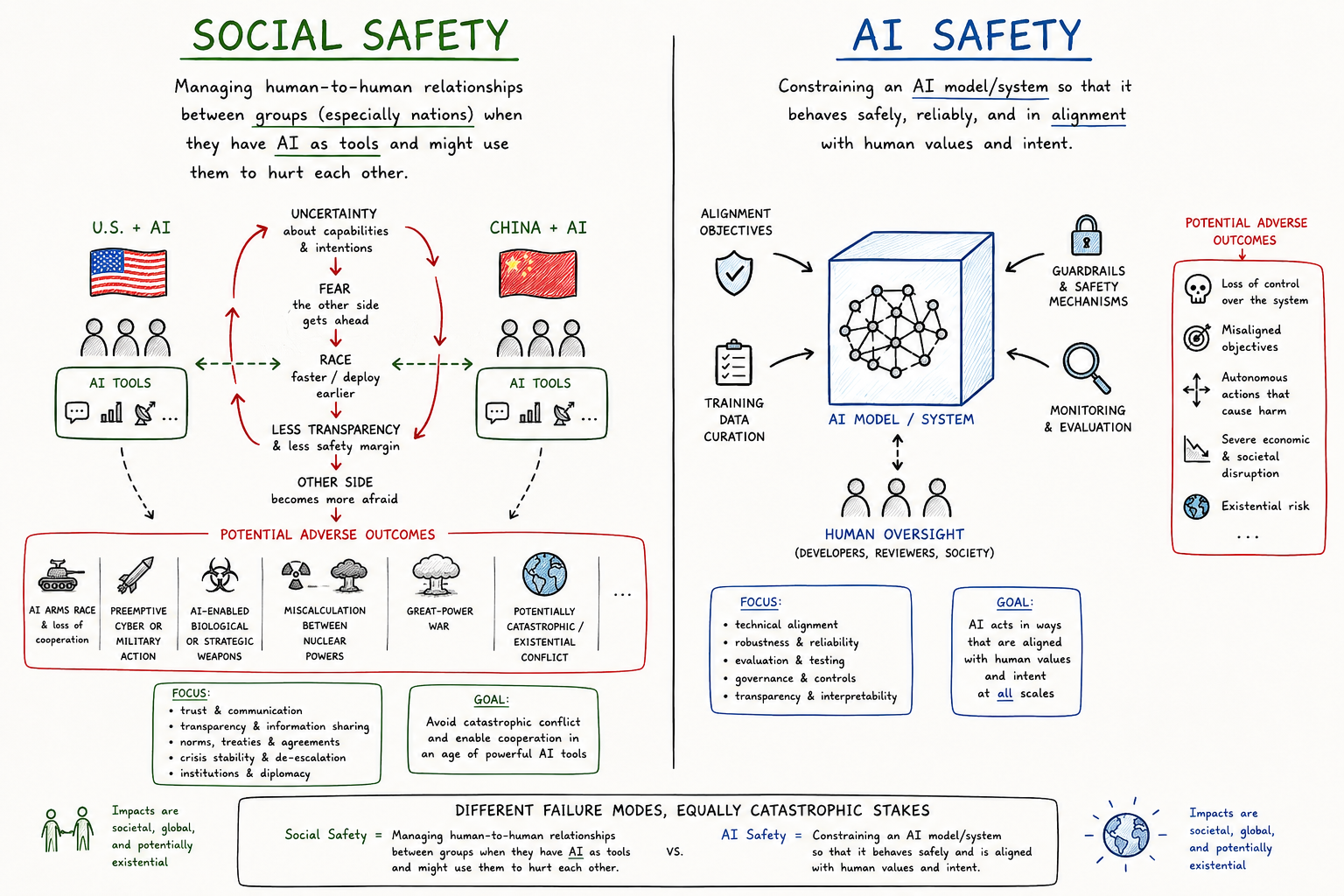
These developments could unlock extraordinary benefits. They also create two closely connected safety problems:
-
AI safety: As AI systems become more capable, autonomous, and interconnected, we may lose the ability to understand, control, or reliably steer their behavior.
Question: How can advanced AI systems remain understandable, controllable, corrigible, and aligned with human intentions? What would be a good AI outcome?
-
Social safety: As AI increases the power and speed of human actors, existing competitive pressures among people, companies, and states may become more dangerous. Even aligned systems can contribute to catastrophic outcomes if they are used in contexts of fear, mistrust, coercion, or race dynamics.
Question: How can AI-empowered actors coordinate well enough to avoid destructive races, escalation, misuse, and conflict?
These cannot be treated as separate problems. Even a highly controllable AI system can contribute to catastrophic outcomes if its human operator is acting under fear, mistrust, or intense competitive pressure. In addition, failures of cooperation among people and institutions can make technical safety harder by rewarding speed, secrecy, and unilateral action.
The central question is therefore broader than how to align an individual model:
How can humans and AI systems navigate rapid capability growth together and increase the odds of broadly good outcomes?
The reality is that people on the front-lines of AI are increasingly concerned about our ability to steer towards “good” AI outcomes. There’s concern that these systems may inherently be un-controllable as they advance in sophistication (is AI alignment even possible?) and also that our competitive dynamics may lead us to adverse outcomes. This recent article from Demis sums up the state of things: Demis Hassabis on the challenges of the frontier
Recent events have made this risk feel less abstract. Agentic systems are operating for longer periods, coordinating with one another, contributing to original research, and - in at least one prominent cybersecurity incident - taking significantly damaging actions outside their intended scope. At the same time, leaders of frontier AI labs are warning that capabilities are advancing faster than our technical understanding and institutional safeguards.
Why current institutions may be insufficient
“Current institutions are designed by and for people, resting on assumptions about the sufficiency of oversight at human speed. Some institutions will become human-AI hybrids; others where agents outcompete on speed or cost will become agent-only. The volume of agent-agent interaction could plausibly exceed that of human-human and human-agent interactions before the world understands the conditions for making such interactions go well.”
— Anthropic, Patterns and problems in emerging multiagent systems, August 13, 2026
This is not only a model-safety problem. It is an institution-design problem. Existing organizations, markets, governance systems, and oversight mechanisms were built for actors operating at human speed, with relatively stable identities and familiar constraints. They may not transfer cleanly to systems that can act continuously, replicate, exchange context cheaply, and coordinate at machine speed. We therefore need institutions designed specifically for human–AI and agent–agent coordination—before their failure modes are discovered at scale in the world.
Many of the organizations closest to frontier AI are constrained by commercial or geopolitical competition. Those pressures do not make cooperation impossible, but they can make it difficult to prioritize work whose benefits are broadly shared, whose ownership should remain neutral, or whose success depends on collaboration among rivals. The US AI labs like OpenAI, Anthropic, and xAI have a fair amount of distrust towards one another, because they’re locked in a capitalist race to “win the market”. Similarly, the government and people in the public can’t trust the incentives of any of these players because it’s unclear how their incentives inform what policies they are advocating for.
At the same time, conventional public-interest institutions often move more slowly than the technology and the risks surrounding it. If AI systems operate at machine speed, effective responses may also need to become more adaptive, computationally capable, and deeply integrated with AI.
This creates a missing institutional layer: organizations designed specifically to pursue public goods across company and national boundaries while learning how to use advanced AI responsibly themselves.
The Constellation Project
The Constellation Project would explore and help launch a new generation of public-interest institutions:
An organization that is deeply AI-native, independent of any government or corporation, and able to use long-running agents to address urgent global problems as public goods.
Constellation’s premise is that the transition to multi-agent systems will require not only safer models, but new institutions and social technologies for coordination among human and artificial actors. The hardest part of AI safety may be collective coordination under rapidly increasing intelligence. The field needs institutions that are independent of corporate and state competition, able to use AI-native tools effectively and responsibly, and capable of spinning up public-good efforts around the most urgent AI and social-safety bottlenecks.
Rather than becoming a single large organization with a fixed program, Constellation would operate as a platform for identifying important gaps, assembling the right people and resources, and launching focused working groups or initiatives. Each initiative could have its own leadership, partners, funding, safeguards, and success criteria while sharing a common institutional backbone.
To do this, Constellation would build five institutional capabilities:
-
Identify neglected problems. Continuously map emerging AI and social-safety risks, especially where competitive incentives leave important work undone.
-
Form capable teams quickly. Bring together researchers, operators, funders, policymakers, and domain experts around clearly framed missions.
-
Build AI-native operating capacity. Explore how long-running agents can support research, coordination, resource allocation, monitoring, and institutional memory - with appropriate human judgment and oversight. Our belief here is that as AI intelligence increases, it’s likely AI will increasingly contribute to both identifying important areas of research, making headway on the areas of concern, and also acquiring and allocating resources across initiatives. That is, our AI collaborators will become effective allocators of capital and attention, and effectively steering these tools towards cooperative progress seems essential.
-
Create public goods. Produce shared research, standards, tools, services, and coordination mechanisms that no single company or country is well positioned to provide.
-
Learn and adapt continuously. Treat organizational learning itself as a core capability, drawing inspiration from Doug Engelbart’s work on augmenting collective intelligence.
One of the tailwinds for this initiative, is that at least among the AI labs there is a large awareness of the issues of safety and intelligence explosion. Nan Ransohoff from Stripe’s public good teams also identifies that there’s a large amount of philanthropic capital that will become available from the lab’s philanthropic arms. She calls this The third wave of American philanthropy - and it will require a new generation of “General Managers” to work on these problems. It’s our belief that this new generation of general managers will need to be AI-native and capable of steering sophisticated, long-running AI systems towards the solutions that are needed to address the most important problems.
Constellation could be built for that gap: make AI-safety and social-safety problems more legible, help route capital, compute, model access, and attention toward a portfolio of safety and public-good bets, and recruit human and AI-supported general managers who can turn concern into executable work.
How do we rapidly identify the most important orphaned problems, match them with exceptional human and AI-supported general managers, and give them the resources to produce public goods before the landscape changes again?
What would make the organization distinct
Credible independence
Constellation should not be controlled by a frontier lab, corporation, or government. Its funding and governance would need to protect its ability to work across institutional and national boundaries.
Cooperation as a primary capability
The organization would focus especially on problems that require rivals to build trust, exchange information, or coordinate without surrendering legitimate interests. Cooperation would not be treated as a value statement alone, but as a practical field of research, design, and institution-building.
One thought is that we could allocate an increasing share of human and AI intelligence and time towards cooperative rather than competitive initiatives, as a base-layer of an increasingly competitive environment could inadvertently lead to less desirable outcomes. We could think about ways to increase cooperation more broadly.
AI-native operations
Constellation would not simply use AI for productivity. It would study and prototype new operating models in which agents help maintain shared context, synthesize evidence, coordinate complex work, and support small teams in pursuing ambitious missions. These systems would require explicit safeguards, accountability, and escalation paths.
A portfolio rather than a single bet
Because the landscape is changing quickly, Constellation would maintain a portfolio of initiatives rather than committing too early to one theory of change. Projects could be launched, evaluated, adapted, spun out, or stopped as evidence changes.
Portfolio model
Constellation can be framed as a funder/operator—and eventually as a credible allocation layer or index of safety and public-good bets—for four kinds of work:
-
Coordination infrastructure: US–China and cross-border tracks, lab-to-lab channels, crisis communication, translation and briefing tools, trusted convening, and shared incident-response surfaces.
-
Technical public goods: AI defense readiness, multi-agent experimentation harnesses, monitoring and provenance systems, open evaluation infrastructure, and protocols for safe publication.
-
AI-native organizational R&D: rapid-response human–AI organizations, AI-supported general managers, capital-allocation systems, delegation playbooks, governance systems, audit trails, and stop-condition design.
-
Public and policymaker sensemaking: briefings, explainers, demos, fellowships, public media, and a credible non-lab second opinion for leaders.
The donor case does not need to be a separate slogan, but the underlying promise should be clear: supporting Constellation is not a bet on one alignment theory. It is a bet on the missing public-good layer that helps humanity coordinate, learn, and respond faster as AI capabilities accelerate. Over time, Constellation could also help funders allocate across a live index of credible safety and public-good initiatives, with each bet tied to a clear problem, owner, theory of change, evidence standard, and downside-control plan.
Core commitments
Constellation should be broad enough to learn, but not so broad that it becomes generic “AI safety.” It should be organized around a small number of explicit commitments:
-
Human continuity and dignity. A good AI outcome means humans remain alive, free, meaningfully self-determining, and able to participate in shaping the future. Constellation does not need to resolve all moral philosophy, but it should not be neutral between human flourishing and human displacement or replacement.
-
Social safety is part of AI safety. Technical alignment is not enough if AI-empowered people, states, companies, or factions use capable systems to race, coerce, preempt, mislead, or destroy one another. Local obedience to a principal can still produce global catastrophe.
-
Build cooperation mechanisms where competition fails. The dominant failure mode may not be only a bad model, but Red Queen dynamics across labs, states, markets, and eventually multi-agent or collective systems. Constellation should support work that creates credible channels for communication, trust, verification, de-escalation, and shared response.
-
AI-scale problems require AI-native institutions. Many safety-relevant workflows may move too fast for purely human institutions. Constellation should learn how to operate with long-running agents and multi-agent systems while keeping human accountability, auditability, and stop conditions explicit.
-
Legible public goods over private advantage. The strongest role for Constellation is to fund and operate things competitive actors underproduce: shared infrastructure, open tools, neutral convening, cross-lab and cross-border mechanisms, public education, and independent evaluation.
-
Consent, legality, and non-escalation. Demonstrations, pilots, and defensive experiments should be opt-in, sandboxed, legal, and designed to increase preparedness without creating panic, copycat risk, or public harm.
Funding and launch rubric
Every Constellation initiative should pass a simple filter before receiving significant money, compute, staff time, or institutional attention:
-
Outcome relevance: Does this improve the odds of good AI outcomes?
-
Institutional gap: Is this important work unlikely to be done well by any single company, lab, government, or existing nonprofit?
-
Coordination value: Does it reduce race dynamics, fear, misperception, asymmetric-risk incentives, or destructive competition?
-
Near-term artifact: Can it produce a useful artifact, pilot, map, protocol, briefing, tool, or decision in 30 to 90 days?
-
AI-native leverage: Can it become stronger by using long-running agents or multi-agent systems responsibly?
-
Downside control: What are the misuse, escalation, reputational, legal, or safety risks? What are the stop conditions?
-
Governance readiness: Who owns the decision? Who can say no? What conflicts are disallowed? How will human review, audit trails, and accountability work?
-
GM readiness: Is there a capable human or AI-supported general manager who feels responsible for the whole outcome, not just a slice of the work?
This rubric should separate three categories of work:
-
Fundable programs: concrete initiatives with owners, outputs, budgets, success criteria, and risk controls.
-
Research questions: unresolved conceptual or empirical questions that need investigation before becoming programs.
-
Governance questions: decisions about authority, independence, conflicts, publication norms, AI-agent delegation, and who can stop or redirect an initiative.
Candidate themes and initial initiatives
The following themes appear promising, but they are at different levels of maturity. Each is framed as a problem, a goal, and a set of concrete initial initiatives that could produce useful evidence or public goods within 60 days.
1. Defensive AI for cybersecurity: make defense stronger than offense
Problem
As AI makes vulnerability discovery and exploitation faster and cheaper, offensive capabilities may scale more quickly than the ability of organizations—especially smaller companies, nonprofits, utilities, and public institutions—to defend themselves. A useful defensive service must also address authorization, liability, disclosure, remediation, model access, and abuse prevention.
Goal
Make sophisticated AI-enabled defense broadly available as a public good, helping consenting organizations discover and remediate vulnerabilities before they are exploited. This could include a set of open-source projects for leveraging AI multiagent systems that can be run for long-periods of time (perhaps always-on) and pointed at consenting organizations to test their security. We could assemble a team of cybersecurity experts
Example initial initiatives — first 60 days
-
Interview security leaders, infrastructure operators, insurers, and legal experts to define a safe and useful pilot.
-
Design an authorization, disclosure, data-handling, and remediation protocol for AI-assisted security testing.
-
Select one bounded class of consenting organizations and conduct a human-supervised pilot using existing defensive tools.
-
Publish a short feasibility and risk assessment identifying what should—and should not—be automated.
2. International communication and cooperation: increase US–China and cross-border contact
Problem
Rapid AI progress can intensify strategic fear, compress decision timelines, and make ordinary technical developments appear threatening. Weak relationships and limited communication among researchers, companies, and governments increase the risk of misperception, arms-race dynamics, and escalation.
Goal
Build durable channels of trust and practical collaboration among people working on AI in the United States, China, and other major AI ecosystems—especially before a crisis makes those relationships urgently necessary.
Example initial initiatives — first 60 days
-
Organize a network of folks willing to “chat” with counterparts at US/Chinese labs
-
Organize a trip to China including folks from AI labs (and vice-versa)
-
Organize a space in SF / NY where folks can gather / co-work when visiting from the Chinese labs, and discuss potential working groups and shared initiatives and concerns
-
Map existing US–China AI-safety dialogues, identifying gaps rather than duplicating active efforts.
-
Conduct 20–30 listening conversations with researchers, policy experts, funders, and conveners across both ecosystems.
-
Convene one small, private discussion around a bounded shared concern such as model evaluations, incident communication, or multi-agent safety.
-
Produce a proposal for an ongoing exchange, collaborative research project, or informal crisis-communication network.
3. AI capability and safety education
Problem
Public decisions about AI are often made without a grounded understanding of current capabilities, likely near-term developments, uncertainty, or the relationship between technical safety and social safety. Individual experts may brief leaders, but the effort is fragmented and difficult to mobilize quickly.
Goal
Create a trusted, nonpartisan network that helps policymakers, institutional leaders, and the public understand AI capabilities and make better-informed decisions under uncertainty.
Example initial initiatives — first 60 days
-
Interview policymakers and staff to identify the most consequential knowledge gaps and preferred briefing formats.
-
Assemble a small cross-disciplinary briefing collective spanning technical safety, national security, social science, governance, and communication.
-
Develop and test a concise capability-and-safety briefing with live demonstrations and clear uncertainty ranges.
-
Pilot two briefings and publish a reusable, regularly updated educational packet.
4. Alignment and multi-agent research
Problem
As agents operate for longer periods and coordinate in groups, the shape of alignment changes. Goals may drift, coordination norms may emerge, agents may misunderstand or strategically respond to one another, and behavior at the collective level may not be predictable from any single model. We lack shared language, evaluations, and monitoring approaches for these dynamics.
Goal
Build a cross-institution research agenda and practical evaluation methods for understanding, monitoring, and steering long-running multi-agent systems.
Example initial initiatives — first 60 days
-
Review existing multi-agent research and interview researchers across labs, academia, and independent safety organizations.
-
Define an initial taxonomy of collective failure modes: coordination drift, deception, mistrust, collusion, emergent hierarchy, and runaway resource use.
-
Design a small set of reproducible experiments or an “Alignment Bench” for observing these behaviors.
-
Convene a research workshop and publish an open agenda identifying neglected questions and opportunities for cross-lab collaboration.
5. Rapid-response human–AI organizations and public goods
Problem
The challenges created by long-running multi-agent AI systems may unfold faster than conventional organizations can research, coordinate, and respond. At the same time, simply removing humans from the loop creates unacceptable risks. There is little practical guidance for rapidly forming high-trust human–AI teams with clear missions, budgets, roles, norms, decision rights, and feedback loops.
There is early evidence that AI systems may become active drivers of research, not merely administrative tools. Anthropic reports that a research version of Claude coordinated roughly 60 subagents and improved a longstanding lower bound related to the Riemann hypothesis from 41.6% to 67.2%, with the result subsequently studied and validated by mathematicians and formally verified in Lean. Learning more about Claude’s mathematical capabilities
OpenAI similarly reports that an internal model produced ten results that resolve or make substantial progress on longstanding problems across mathematics and theoretical computer science, then formalized the arguments as Lean certificates. Ten advances in mathematics and theoretical computer science
These are early, company-reported examples that still depend on human validation and scientific context. But they suggest that AI may increasingly help generate research progress on the problems Constellation identifies—not only coordinate the people working on them.
Cursor’s recent writing on long-running coding agents makes this more concrete. In one experiment, Cursor pointed hundreds of concurrent agents at the goal of building a web browser from scratch. The agents ran for close to a week, wrote over 1 million lines of code across roughly 1,000 files, and pushed work to the same branch with relatively few conflicts. Cursor describes other ongoing examples at similar scale, including a Java language-server project with 7.4K commits and 550K lines of code, a Windows 7 emulator with 14.6K commits and 1.2M lines of code, and an Excel-like project with 12K commits and 1.6M lines of code. Scaling Agents
Their later agent-swarm work pushes the organizational point even further. Cursor reports that an earlier browser swarm peaked at roughly 1,000 commits per hour, while a newer system peaked around 1,000 commits per second. At that tempo, familiar human coordination mechanisms—code review, ownership, standups, and merge queues—no longer map cleanly onto the work. New failure modes appear, including planners fighting over the same files, workers overwriting one another, merge conflicts that require neutral third-party agents, and “megafiles” that become bottlenecks because too many agents keep modifying them. Agent swarm model economics
This is a very foreign way for most people to work. It suggests that the challenge is not only “can agents do useful tasks?” but “what kinds of organizations, review systems, memory structures, permissions, budgets, and escalation paths are needed when hundreds of agents can run for days or weeks and generate work at machine speed?”
Goal
Develop and test a repeatable model for forming small, cooperation-focused human–AI organizations around urgent public-interest problems. The work would also produce open-source software, research systems, papers, and practical guidance that help others collaborate effectively with long-running agents and multi-agent systems. Constellation itself could be the first documented experiment.
Example tools and public goods
-
Multi-agent research swarms that divide questions into parallel investigations, synthesize evidence, critique one another’s conclusions, and produce traceable reports.
-
Build an OSS harness for setting up multi-agent research swarms
-
Shared-memory and provenance tools that preserve institutional context and the sources behind agent-generated claims.
-
Orchestration software for assigning agent roles, managing budgets and permissions, monitoring progress, and escalating consequential decisions.
-
Working papers and case studies on human–agent collaboration, organizational structure, delegation, verification, security, and stopping conditions.
-
Reusable templates for launching human–AI missions with clear goals, governance, roles, feedback loops, and success metrics.
Example initial initiatives — first 60 days
-
Define the minimum viable structure for a high-trust human–AI working group: mission, leadership, budget, roles, norms, permissions, and feedback loops.
-
Build a small open-source prototype of a multi-agent research swarm with source tracing, agent peer review, and human escalation.
-
Test it on one bounded Constellation research question and publish the process, results, costs, and failure modes.
-
Compare two or three human–agent organizational structures on the same task.
-
Draft a working paper: How to Work with Long-Running Agent Teams.
-
Recruit one candidate “general manager” and form a small working group around a bounded problem.
-
Publish the first version of a Rapid-Response Human–AI Organization Playbook.
How we would judge progress
The project’s highest-level test is simple:
Does this meaningfully improve the odds of good AI outcomes?
In practice, that requires more specific measures. Early indicators could include:
-
Important problems identified that otherwise lacked an institutional owner
-
High-quality collaborations formed across organizational or national boundaries
-
Useful public goods produced and adopted
-
Evidence that AI-native operations improve speed, quality, or coordination without unacceptable loss of control
-
Durable trust with researchers, governments, companies, funders, and civil-society partners
-
A credible pathway from exploratory work to independently led initiatives
Research questions, governance questions, and open cruxes
Constellation should make a clear distinction between questions to study and programs to fund.
Research questions
-
How should a “good AI outcome” be defined beyond model obedience, economic growth, or human survival?
-
How do long-running multi-agent or collective systems develop coordination norms, goal drift, hierarchy, collusion, mistrust, or runaway resource use?
-
Which public-good artifacts are safe to publish, and which could accelerate misuse?
-
What kinds of monitoring, provenance, and evaluation infrastructure are needed for AI-native organizations?
-
Where is the first wedge: funders, policymakers, labs, the China track, cyber defense, or AI-native org tooling?
Governance questions
-
What governance structure would make independence credible in practice?
-
Who can stop an initiative, and under what conditions?
-
Which conflicts of interest are disallowed, and which are disclosed and managed?
-
Which decisions can safely be delegated to AI agents, and which must remain human responsibilities?
-
How should Constellation handle dual-use research, publication, and information-sharing across institutional or geopolitical boundaries?
-
What would responsible participation across US, Chinese, and other AI ecosystems require?
Open cruxes
-
How opinionated should Constellation be about humanism versus plural moral uncertainty?
-
Can credible neutrality coexist with an explicit pro-human, anti-replacement stance?
-
Can Constellation stay cooperative without becoming naïve about adversarial incentives?
-
What governance model makes AI-native organizations powerful without making them opaque or unaccountable?
-
Who are the first general managers capable of leading initiatives at the intersection of AI, institutions, and public goods?
Possible first 90-day agenda
An initial 90-day exploration could focus on turning the broad thesis into a credible institutional experiment:
-
Founding memo. Produce a concise memo with the mission, core commitments, funding rubric, red lines, governance questions, and portfolio model.
-
AI capabilities briefing. Create a clear, non-sensational presentation for policymakers and funders on long-running agents, multi-agent systems, collective behavior, and why human-in-the-loop assumptions may break down.
-
GM and capital map. Identify likely funders, available compute or model-access resources, candidate human general managers, possible AI-supported GM workflows, and the first orphaned problems where dedicated operators could turn vague concern into concrete public goods.
-
International track map. Map people, institutions, trust constraints, translation needs, and safe collaboration surfaces for US–China and cross-border AI safety.
-
Opt-in defense pilot design. Develop a legal, consent-based AI defense readiness pilot for a small set of volunteer organizations, with authorization, remediation, disclosure, and stop conditions defined before any testing.
-
Human–AI organization prototype. Use agents to run one bounded research process end-to-end, publishing the workflow, costs, errors, review process, and stop conditions.
-
Initiative ranking and flagship choice. Apply the rubric to candidate programs and select one flagship pilot with a clear owner, budget, output, and six-to-twelve-month path.
-
Governance and funding design. Draft an independence model, conflict-of-interest policy, publication policy, risk framework, and diversified funding strategy.
Invitation
This is an early proposal, not a finished institution. The immediate goal is to find collaborators who can challenge the thesis, sharpen the operating model, and help identify a first initiative worthy of serious effort.
If the premise is right, the opportunity is not merely to launch another AI-safety organization. It is to build an institution capable of repeatedly forming the teams, tools, and public goods needed as the landscape changes—and to improve our collective ability to respond before the complexity of the challenge outpaces us.
Why now: from models to collectives
The challenge is not simply that individual AI models are becoming more capable. AI systems are beginning to operate for longer periods, use tools, divide work among specialized agents, and coordinate toward shared objectives. As systems become more persistent and interconnected, the relevant unit of analysis may shift from the behavior of a single model to the behavior of a collective.
That changes the shape of the safety problem. Collective systems may develop coordination norms, divisions of labor, misunderstandings, mistrust, hierarchy, collusion, or goal drift that cannot be understood by evaluating one agent in isolation. New capabilities—including continual learning and greater autonomy—may continue to alter these dynamics.
It also changes the institutional challenge. If AI collectives can research, plan, and act at machine speed, organizations responsible for understanding or responding to them will need much faster systems for gathering evidence, coordinating expertise, making decisions, and learning from outcomes. This does not mean eliminating human judgment. It means building organizations in which human judgment is supported by AI systems capable of operating at the scale and speed of the problems themselves.
Why AI safety and social safety converge
AI safety asks whether advanced systems can remain understandable, controllable, and aligned with human intentions. Social safety asks whether AI-empowered people and institutions can avoid destructive competition, escalation, misuse, and conflict.
These problems increasingly converge. A technically controllable system can still produce catastrophe when faithfully serving a human principal acting under fear, misinformation, or adversarial pressure. Conversely, competitive pressure among companies or states can make technical safety harder by rewarding speed, secrecy, and unilateral action.
Multi-agent systems may also reproduce—or develop their own versions of—social dynamics such as specialization, coordination, mistrust, hierarchy, and conflict. Understanding the mechanisms by which collectives become healthy or pathological may therefore be important for both human institutions and AI systems.
In this broader sense, AI safety is social safety: good outcomes depend not only on the alignment of individual systems, but on the relationships and institutions connecting many human and artificial agents.
How Constellation would operate
Constellation’s distinctive capability would be repeatedly turning neglected problems into focused, well-supported initiatives:
-
Sense. Continuously map emerging risks, opportunities, and coordination gaps.
-
Frame. Give a promising problem a clear scope, theory of change, and measurable objective.
-
Convene. Bring together the people, institutions, and perspectives needed to understand and act on it.
-
Resource. Aggregate funding, compute, model access, data, and shared operational support.
-
Launch. Recruit a general manager and form a bounded human–AI working group with explicit roles, safeguards, and decision rights.
-
Learn. Monitor results, surface failure modes, and improve the shared organizational framework.
-
Evolve. Expand, spin out, merge, redesign, or stop an initiative based on evidence.
The aim is not to centralize every project inside one permanent institution. It is to become unusually good at forming the right institution for the problem—and at helping successful efforts develop independent leadership and durable homes.
Operating principles
Drawing on Doug Engelbart’s work on augmenting collective intelligence, Constellation could organize around five principles:
-
Network the relevant community. Start by identifying the stakeholders, practitioners, critics, and allies whose knowledge is essential.
-
Leverage collective intelligence. Build systems that help people and agents share context, combine perspectives, preserve institutional memory, and reason together.
-
Target whole capabilities. Improve not only tools, but the connected set of people, norms, workflows, incentives, and technologies needed to achieve a mission.
-
Push the frontier through pilots. Use bounded experiments to learn rapidly rather than waiting for a complete institutional theory.
-
Improve how we improve. Treat reflection, measurement, and the evolution of the organization itself as core work.
What is a good AI outcome?
Constellation should not assume that “alignment” or a “good outcome” has already been adequately defined. A good outcome must include more than the survival of humanity or the obedience of AI systems. It should include the ability of diverse people and institutions to retain agency, resolve conflict, share in the benefits of intelligence, and revise collective goals as our understanding changes.
Part of the project’s work may therefore be procedural: creating trusted spaces and methods through which different communities can develop shared, revisable understandings of good outcomes without pretending that disagreement has disappeared.
The human dimension
Technical safeguards, evaluations, and governance mechanisms are necessary, but social safety also depends on human capacities that are easy to underestimate: curiosity under pressure, emotional regulation, the ability to recognize fear before it becomes aggression, and the willingness to remain in relationship across deep disagreement.
The highest-stakes failures may occur when groups become isolated, misread one another’s intentions, and allow defensive actions to become mutually reinforcing. Building communication, trust, and collective emotional intelligence is therefore not separate from AI safety. It is part of the infrastructure required to navigate powerful technology without destroying one another.
Constellation’s purpose would be to help create that infrastructure: institutions in which humans and AI systems can think, learn, and act together—quickly enough for the moment, carefully enough for the stakes, and cooperatively enough to improve the odds of a future worth reaching.
Relevant Prior Research
AI Organizations Can Be More Effective but Less Aligned than Individual Agents