Notes on Weaving the Web: Imagining an AI-First Web
Re-reading Weaving the Web and reflecting on what the founding vision of the web tells us about where the web is going, and building a web for AI
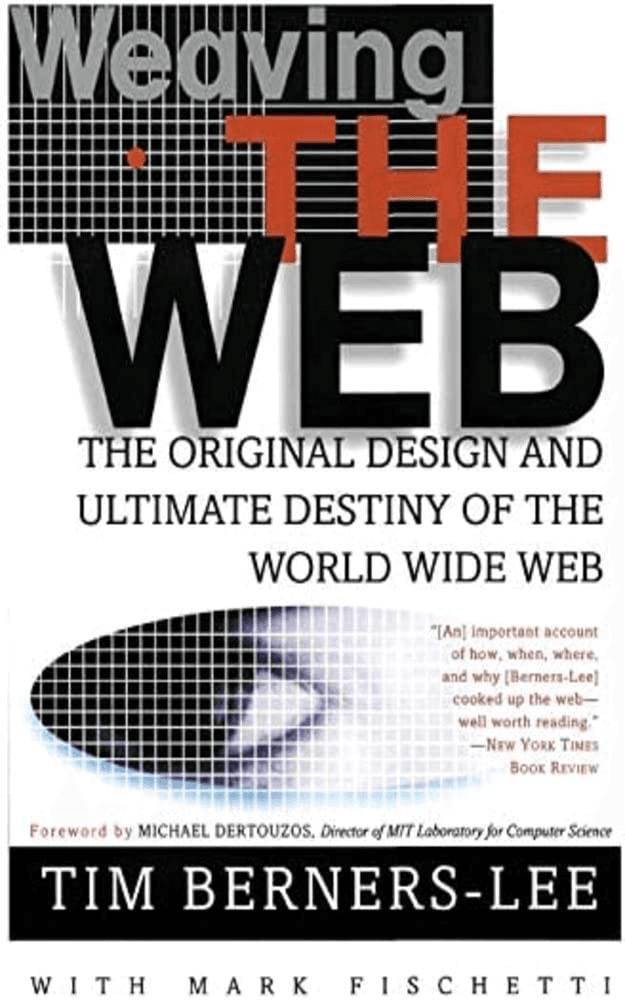
As 2024 was coming to a close, I felt inspired to re-read and reflect on the book that originally got me interested in becoming a programmer and entrepreneur: Sir Tim Berners-Lee’s Weaving The Web: The Original Design and Ultimate Destiny of the World Wide Web. Sir Tim Berners-Lee is the Web’s creator, early developer and ongoing steward, and the book, written in 1999, is his own telling of the early days of the ideas that came to become the World Wide Web.
I first read the book when I was 20 years old, on a study abroad exchange in Copenhagen. The urge to revisit the book came to me in a dream, and a sort of longing to recall what got me excited about the internet and technology in the first place. When I read that book, I remember being inspired by just how beautiful, simple, and consequential a concept the web could be — a protocol anyone could participate in, to add information to a collective web, addressable, and linkable together to form a digital mesh of humanity’s collective knowledge and experience. Given where we are today, it’s wild to consider that the web started only in 1993, a little more than 30 years ago.
Sometimes you go back to something you loved when you were young, and think, “Oh man, this didn’t age well…”. That is definitely not the case here. Re-reading this book awoke the spark and sense of wonder I had as a 20-year-old, and made me re-appreciate just how prescient and clear Sir Tim Berners-Lee’s thoughts were. I love this book! It should be much more popular than it currently is, so please do read it and tell your friends.
With the vantage of 30 years, we can look back at those simple ideas, and even more fully appreciate the elegance with which he communicates them. I’ll share some of the excerpts and themes that jumped out to me chapter by chapter, and my reflections on a few of the passages and concepts explored. I love how simple ideas can ripple out into powerful combinatorial effects, and the web is one of the best representations of the impacts of a combinatorial space for ideas and experiences, and what can emerge from them.
Here in 2026, riding the curve of AI’s increasing intelligence, we can see how the web’s concepts stacked to lead to our increasingly digital lived experiences: we got Google and search engines, Wikipedia, social media and the substantial collapse of traditional media, e-commerce, the personalized feed, online advertising, and all the challenges of society trying to figure out how to be online together. Even in 1993, and then reflecting back in 1999, Tim Berners-Lee saw the glimmers of what was to come, both in terms of the web’s impact on commerce, and the challenges we would face in collectively navigating truth, combatting online surveillance, and trying to restructure and rethink democracy in the digital age.
I’d highly recommend reading the book yourself, and Sir Tim Berners-Lee also has another book that has come out recently that I’ve been meaning to read: This is for Everyone: The Unfinished Story of the Web

Themes we’ll explore
This book, I believe, is not nearly as popular and well-known as it ought to be, and I also believe Sir TBL is not as celebrated and well known as he ought to be — so maybe this can also be my small part in at least communicating my appreciation, and sharing some small excerpts that inspire you too.
There’s sadly not a Kindle version of this book available, but you can buy physical copies here: Weaving the Web — Amazon. It’s often a book I gift to friends working in tech. If I can help get this book into Kindle form, it’s something I’d do, or if Sir TBL wants to work on making an openly accessible HTML-first version.
You can also borrow the book from the Internet Archive for free here: Weaving the Web — Internet Archive
- What inspired me about this book in the first place: The core concepts of the web, and how he tinkered and distilled them over several years. I think it’s a beautiful example of exploring the space of possible ideas, and conceptual refinement and design. The importance of it being a free, distributed protocol rather than a paid, centralized one, and how that led to open innovation on top — also his own decision to embrace this path for the benefit of its becoming universal and widespread despite any challenges in commercializing it.
- AI and the web. As you’ll see, one of the first things Sir TBL tried to explore was building something akin to an LLM. It’s striking that the web is a prerequisite for developing Large Language Models on the path we’ve gone on, where we needed a large amount of digital data that could be mined for patterns in order to allow LLMs to emerge.
- What is the future of the web, what is a web designed for AI agents?
- What can we learn about the central issues of the web that we’re still grappling with today as a society?
The table of contents of the book is below, with brief summaries of each chapter. I suppose in some ways, what I’m sharing in this blog post is my own brain’s annotations as I re-read the book all these years later.
I didn’t have time to edit all the chapter notes yet, so I’ve just gotten through the first 3, and will continue to add to this post.
Book Table of Contents
- Enquire Within upon Everything — 1
- Tangles, Links and Webs — 8
- info.cern.ch — 27
- Protocols: Simple Rules for Global Systems — 38
- Going Global — 57
- Browsing — 73
- Changes — 81
- Consortium — 97
- Competition and Consensus — 111
- Web of People — 133
- Privacy — 155
- Mind to Mind — 169
- Machines and the Web — 191
- Weaving the Web — 216
Chapter 1: The Vision and Lineage of the Web
I just want to call out that even the first chapter’s title comes out swinging.
What that first bit of Enquire code led me to was something much larger, a vision encompassing the decentralized, organic growth of ideas, technology, and society. The vision I have for the Web is about anything being potentially connected with anything. It is a vision that provides us with new freedom, and allows us to grow faster than we ever could when we were fettered by the hierarchical classification systems into which we bound ourselves. It leaves the entirety of our previous ways of working as just one tool among many. It leaves our previous fears for the future as one set among many. And it brings the workings of society closer to the workings of our minds.
Even in this early passage, one of the main things that Sir TBL was highlighting was the associative, link-based, non-hierarchical nature of our minds, which is so inherent in the hypertext vision of the world wide web. I also really love the idea of implicit and invisible links, and I also really like thinking about LLMs as implicit idea engines.
Suppose all the information stored on computers everywhere were linked, I thought. Suppose I could program my computer to create a space in which anything could be linked to anything. There would be a single, global information space. Once a bit of information in that space was labeled with an address, I could tell my computer to get it. By being able to reference anything with equal ease, a computer could represent associations between things that might seem unrelated but somehow did, in fact, share a relationship. A web of information would form.
What a banger of a thought a global information space is. This must have been a pretty trippy thought at the time, and thinking about the invisible web of links that could form is really beautiful. One of the most beautiful aspects of the web is that you put stuff out, and you have no idea what will link to it and who will find it. It increases the combinatorial space — your surface area for combination and manifest associations.
The lineage: Bush, Nelson, Engelbart
Sir TBL wasn’t working in a vacuum — several visionaries had hit upon similar concepts before him, though none were fully implemented. Vannevar Bush imagined the Memex in 1945, Ted Nelson coined hypertext in 1965 and dreamed up Xanadu, and Doug Engelbart demonstrated collaborative hypertext workspaces in the 1960s (inventing the mouse along the way). Each was too far ahead of their time.
I happened to come along with time, and the right interest and inclination, after hypertext and the Internet had come of age. The task left to me was to marry them together.
This lineage of thoughts, from Vannevar Bush, to Ted Nelson, to Engelbart, is so much of what I’ve felt inspired by in my own career. These ideas saw the beautiful in the potential of our technology, and as Engelbart would put it, the promise of using technology to “Boost mankind’s capability for coping with urgent, complex problems”.
In some ways, I’m dismayed at how the Internet and web technologies have come to manifest in the world. It has elevated the human spirit, but also enabled governments and corporations to use these technologies for surveillance and misinformation. The good aspects of this shared digital space have come with meaningful challenges too as we navigate how that digital space shapes our perspectives, and daily experiences.
Chapter 2: Tangles, Links and Webs
The web solved many problems, but at its core, the problem that it was solving was: there are many different computer systems, different operating systems, different word processors and standards, and no clear way to publish and share information across them. How should people be able to make information available on their machine, to other machines on the network (the Internet), in such a way that they could all predictably know how to access, interpret and present the structure of that information? How could people easily add to such a system without a central node where everyone published? This was the set of problems that the web, as specified by HTTP, URLs (i.e. web addresses), and HTML solved. We’ll get to a bit more on that in the next chapter, but in this chapter Sir TBL shared some of the early inklings and motivations for building the web and wanting to organize information.
Much of the crucial information existed only in people’s heads. We learned the most in conversations at coffee at tables strategically placed at the intersection of two corridors.
I would have to create a system with common rules that would be acceptable to everyone. This meant as close as possible to no rules at all.
This notion seemed impossible until I realised that the diversity of different computer systems and networks could be a rich resource — something to be represented, not a problem to be eradicated. The model I chose for my minimalist system was hypertext.
The Web started as a project inside of CERN, the particle physics research center in Switzerland. It’s fascinating how practically the project started — folks wanted to organize information, but everyone had different computer systems. Sir TBL kept making different attempts to allow people to make systems for publishing and linking together information, and there were lots of challenges to make them stick. In this chapter you also see the minutiae of trying to get an organization to buy into an information organization project like the initial versions of the web were dreamed to be (even though Sir TBL saw its bigger promise).
Tangle: An early version of LLMs
It’s fascinating how even early on, one of the first things that Sir TBL had tried to do was effectively make an LLM. Before building the web, he built Tangle — a program that tried to encode meaning through connections between character sequences:
In an extreme view, the world can be seen as only connections, nothing else. We think of a dictionary as the repository of meaning, but it defines words only in terms of other words. I liked the idea that a piece of information is really defined only by what it’s related to, and how it’s related. There really is little else to meaning. The structure is everything. There are billions of neurons in our brains, but what are neurons? Just cells. The brain has no knowledge until connections are made between neurons. All that we know, all that we are, comes from the way our neurons are connected.
The philosophy was: what matters is in the connections. It isn’t the letters, it’s the way they’re strung together into words. It isn’t the words, it’s the way they’re strung together into phrases. It isn’t the phrases, it’s the way they’re strung together into a document.
Really, this paragraph is in some ways the early version of a neural network — ideas that had been around for centuries in the form of linear regression and connectionism. His point that meaning is just relations — but also tying it to the structure of the human brain — this was a precursor to the deep neural networks that were to come.
I tested Tangle by putting in the phrase “How much wood would a woodchuck chuck?” The machine thought for a bit and encoded my phrase in what was a very complex, tangled data structure. But when I asked it to regurgitate what it had encoded, it would follow through all the nodes and output again, “How much wood would a woodchuck chuck?” I was feeling pretty confident, so I tried it on “How much wood would a woodchuck chuck if a woodchuck could chuck wood?” It thought for a while, encoded it, and when I asked it to decode, it replied: “How much wood would a woodchuck chuck if a woodchuck chuck wood chuck chuck chuck wood wood chuck chuck chuck…” and it went on for ever. The mess it had made was so horrendously difficult to debug that I never touched it again. That was the end of Tangle — but not the end of my desire to represent the connective aspect of information.
It’s interesting to listen to Fei-Fei Li’s recent interview with Tim Ferriss — her big innovation was in part realizing that with sufficient data, there was a path for scaling AI capabilities and making actually useful products: Dr. Fei-Fei Li on the Tim Ferriss Show
Chapter 3: info.cern.ch
In this chapter, Sir TBL explains how he realized that explaining the web conceptually to people was an uphill battle, and he realized he needed to program the end-to-end system to show to people. What’s striking about some of the passages below is how write-first the web was originally — the web client and the ability to make pages were central, and for a long time we lost that. There’s an interesting moment now as AI makes so many more people capable of creating not only websites but entire software applications — the write moment for the web is finally happening, and soon we’ll have more and more tools made by AI agents for AI agents, rather than for humans.
It seemed that explaining the vision of the Web to people was exceedingly difficult without a Web browser in hand. People had to be able to grasp the Web in full, which meant imagining a whole world populated with Web sites and browsers. They had to sense the abstract information space that the Web could bring into being. It was a lot to ask.
Building his own web
So he went and built it. He wrote the first web client (a browser/editor that worked like a word processor), the first web server (running on his NeXT desktop machine, aliased to “info.cern.ch” so it wouldn’t be tied to one machine), and the first web page. By Christmas Day 1990, it was working.
By mid-November I had a client program — a point-and-click browser/editor — which I just called WorldWideWeb. By December it was working with the Hypertext Markup Language (HTML) I had written, which describes how to format pages containing hypertext links.
At this point Robert bought his own NeXT machine and we revelled in being able to put our ideas into practice: communication through shared hypertext.
The big ideas of the web protocol were: HTTP, URIs (URLs), and HTML. The client, browser, and server were the actual engineering artifacts and ways to experience this protocol that allowed making it tangible to people and made the value graspable. There’s a real entrepreneurial journey here that Sir TBL went down that I think is not celebrated enough, which was his ability to say — hey there are these interesting concepts, but to make anyone actually care about it, we need to build something. It’s not enough to just spec it out and write about it, we need to make the actual products that make use of these ideas so that people can experience it in practice.
Bootstrapping the web
You can see his practicality, and how he handled the chicken-and-egg problem step by step. He wasn’t employed by CERN to create the Web — at any moment someone could have questioned how he was spending his time. So his first target was humble: the CERN telephone book.
Mundane as it was, this first presentation of the Web was, in a curious way, a killer application. Many people had workstations, with one window permanently logged on to the mainframe just to be able look up phone numbers. We showed our new system around CERN and people accepted it, though most of them didn’t understand why a simple ad hoc program for getting phone numbers wouldn’t have done just as well.
The WorldWideWeb browser/editor was working on my machine and Robert’s, communicating over the Internet with the info.cern.ch server by Christmas Day 1990.
The key principles
What we had accomplished so far was based on a few key principles learned through hard experience. The idea of universality was key: the basic revelation was that one information space could include them all, giving huge power and consistency.
The system should not constrain the user; a person should be able to link with equal ease to any document wherever it happened to be stored. This was a greater revelation than it seemed, because hypertext systems had been limited works. They existed as databases on a floppy disk or a CD-ROM, with internal links between their files. For the Web, the external link is what would allow it to actually become “worldwide.”
The important design element would be to ensure that when two groups had started to use the Web completely independently at different institutions, a person in one group could create a link to a document from the other with only a small incremental effort, and without having to merge the two document databases or even have access to the other system. If everyone on the Web could do this, then a single hypertext link could lead to an enormous, unbounded world.
Chapters 4–14: To Be Continued
The remaining chapters of the book cover protocols and simple rules for global systems, the web going global, the rise of browsers, the formation of the W3C consortium, competition and consensus, the web of people, privacy, mind-to-mind connections, machines and the web, and Berners-Lee’s vision for weaving it all together. I’ll be sharing my notes and reflections on those chapters in a future update.
Stay tuned.